
Four Functional Directions for Glass Surface Engineering
Glass can be modified for anti-fog, easy-clean, antireflection or antistatic behavior, but each function works through a different physical mechanism.
Anti-fog and easy-clean change wetting behavior
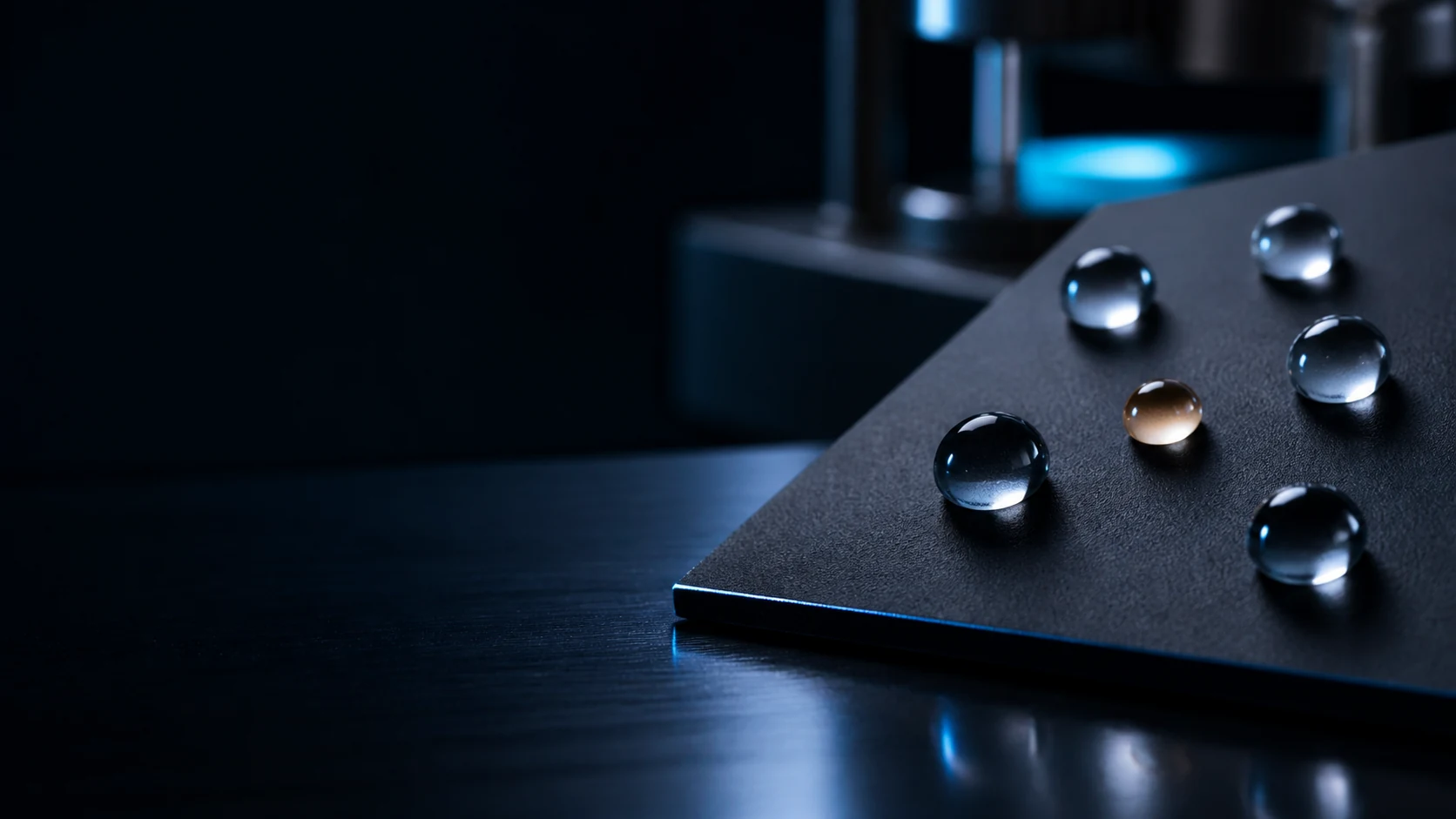
Hydrophilic surfaces promote condensate spreading, while hydrophobic and oleophobic surfaces reduce water, oil and fingerprint wetting. Whether they can coexist depends on the priority assigned to each function.
Antireflection is an optical system
Refractive-index structure, thickness, wavelength, incidence angle and the measurement method control the result. A later easy-clean or other functional layer can change reflectance, transmission and color.
Antistatic design addresses charge
Transparent antistatic materials must balance electrical behavior with haze, adhesion and cleaning durability. Existing optical layers can also change film formation and electrical uniformity.
Combined functions begin with a clear priority
Organic Advanced Materials focuses on hydrophilic anti-fog, hydrophobic easy-clean and antistatic surface materials. For pre-coated or multifunctional glass, the primary use problem is defined first and compatible material routes are then evaluated; antireflection itself remains an optical-system responsibility.
References
- Low-Refractive-Index and Anti-Fingerprint Coating StudyNational Taiwan thesis record 102NCIT5063012
- Fabrication of Transparent Silica/PEG Smooth Thin Coatings on Polymeric Films for Antifogging ApplicationsACS Omega, 2022 · DOI 10.1021/acsomega.1c07293